

Regulation on PhD Programme Standards Officially Published
The Kosovo Accreditation Agency (KAA) has published on its official website the Regulation on Standards for the Evaluation of Doctoral (PhD) Programmes, as approved by the State Council of Quality (SCQ) during its meeting held on 30 June 2025. The regulation, now in force, will serve as the legal basis for all accreditation processes related to PhD programmes in the Republic of Kosovo.
This regulation is the result of an inclusive and consultative process with higher education institutions across the country, and is fully aligned with the Standards and Guidelines for Quality Assurance in the European Higher Education Area (ESG).
The regulation defines a total of 44 standards, of which 26 are core (mandatory) and 18 are additional, structured across seven key areas of evaluation:
- Institutional structure, administrative support, and funding;
- Admission and selection criteria;
- Structure/content of the doctoral programme;
- Research environment and capacity;
- Supervision;
- Assessment; and
- Research outcomes.
Programmes that demonstrate full compliance with these standards may be accredited for up to five years, while those in substantial compliance may receive accreditation for up to three years. Programmes failing to meet the core mandatory standards will not be eligible for accreditation.
The regulation places particular emphasis on:
- High-quality supervision;
- Research integrity and scientific ethics;
- Academic mobility;
- Active participation in international research activities; and
- Publications in peer-reviewed journals indexed in WoS and/or Scopus.
Through this strategic document, the KAA aims to ensure a high level of quality and international alignment of doctoral studies in Kosovo, thereby contributing to the development of a knowledge-based and innovation-driven society.
Professor Melita Kovacevic chaired the expert team responsible for the review of the new standards.
The revision of these standards was supported by the SHER Programme, funded by the Austrian Development Agency (ADA), co-funded by the Ministry of Education, Science, Technology and Innovation, and implemented by the consortium of WUS Austria, ZSI, and OeAD.
To read the full Regulation, click here: Regulation on Standards for PhD Programmes
Full member of:


More From Latest News
4th KAA Annual Conference 2026 Successfully Concluded
The Kosovo Accreditation Agency (KAA) successfully held its 4th Annual Conference on 29 September 2026 in Prishtina, under the theme “Internal Quality Assurance in Higher Education Institutions: From Evaluation to Quality Culture”. The conference brought [...]
SCQ Held Its Regular Meeting
The State Council of Quality (SCQ) of the Kosovo Accreditation Agency (KAA) held its regular meeting on 28 September 2026, during which a number of important matters related to quality assurance in higher education in [...]
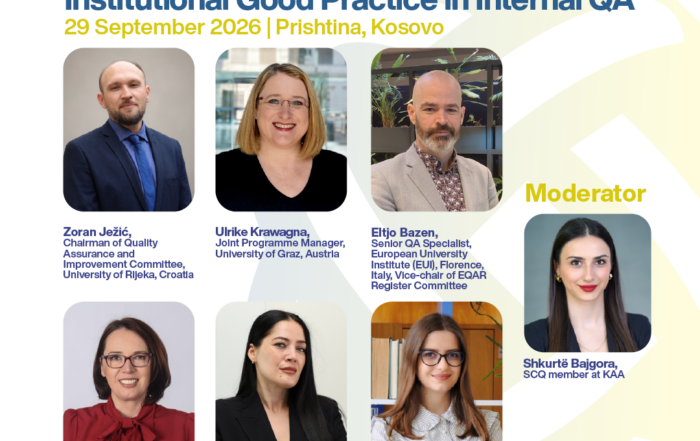
Panel 2: “Institutional Good Practice in Internal Quality Assurance”
Panel 2: “Institutional Good Practice in Internal Quality Assurance” will bring together Zoran Ježić, Ulrike Krawagna, Eltjo Bazen, Majlinda Gjelaj, Furtuna Mehmeti, and Fortina Kastrati, offering diverse perspectives and experiences from higher education institutions in [...]
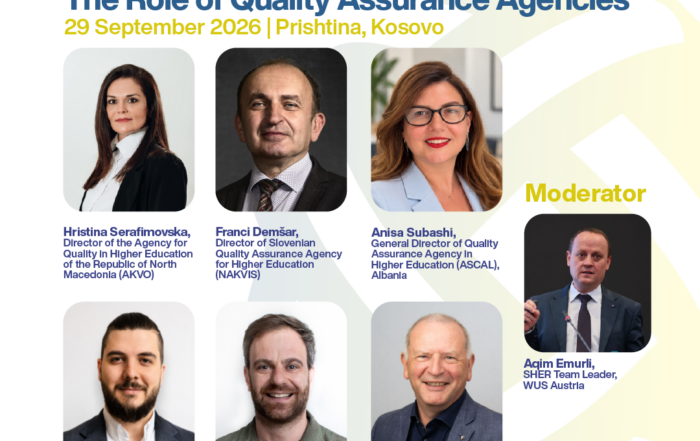
Meet the Panelists of Panel 1 at the 4th KAA Annual Conference
The Kosovo Accreditation Agency is pleased to bring together distinguished experts and leaders in higher education quality assurance for Panel 1: “The Role of Quality Assurance Agencies”. The panel will feature Hristina Serafimovska, Director of [...]
Meet the Keynote Speakers of the 4th KAA Annual Conference
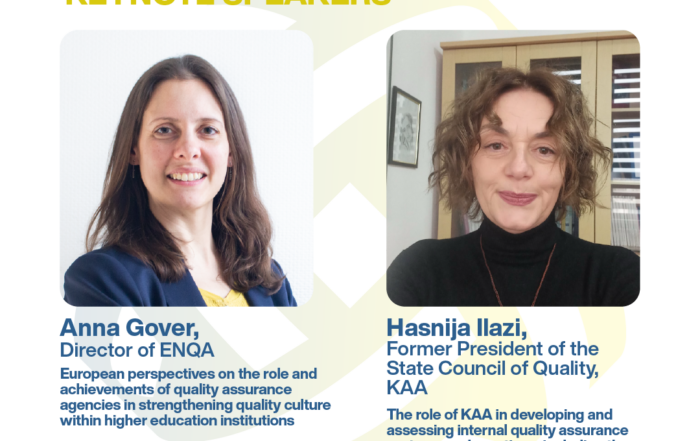
The Kosovo Accreditation Agency is pleased to introduce the keynote speakers of the conference “Internal Quality Assurance in Higher Education Institutions: From Evaluation to Quality Culture”: Anna Gover, Director of ENQA, will present European perspectives [...]
KAA Participates in the International Conference “Future of the Academic Profession”
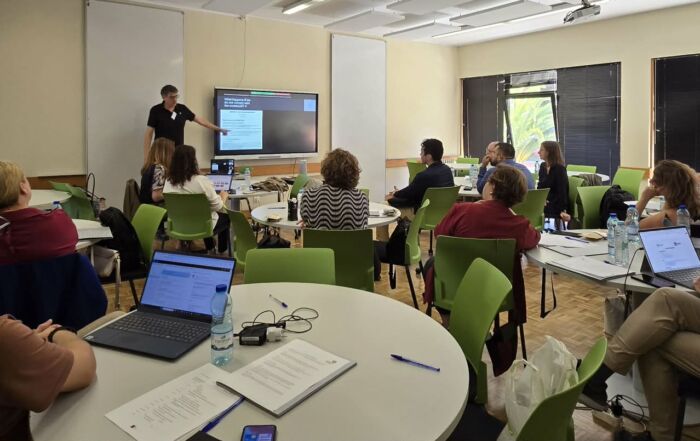
The Kosovo Accreditation Agency (KAA) is participating in the international conference “Future of the Academic Profession”, being held from 7 to 9 September 2026 at the University of Aveiro, Portugal. The KAA is represented by [...]