
The KAA aims to join CHEA and achieve “Recognized Accreditor” status in U.S.A.
On the occasion of the International Conference of the Council for Higher Education Accreditation (CHEA), held in Washington, the Director General of the Kosovo Accreditation Agency (KAA), Naim Gashi, met with CHEA Vice President Michelle Claville. They discussed KAA’s membership in CHEA, initially as a member, and the launch of the process to meet the criteria necessary for the recognition of Kosovo’s accreditations in the United States.
Vice President for Research and Policy Analysis Claville expressed her support for KAA, welcoming it as a member of CHEA and offering full cooperation to support the agency meet the criterias to become a “recognized accreditor” under CHEA.
Director Gashi highlighted that under the Law on KAA, all accreditations issued by institutions recognized by CHEA are valid in Kosovo. He emphasized that the presence of U.S. institutions in Kosovo’s higher education system further underscores the need for KAA to achieve recognition and membership in CHEA.
The meeting was also attended by Professor Olgun Çiçek, a member of CHEA’s International Advisory Council and an international accreditation expert at AKA. Professor Çiçek expressed his readiness to support KAA in meeting CHEA’s criteria through his expertise.
CHEA is a federal-level organization in the United States that recognizes accrediting agencies for higher education institutions. It serves as the U.S. counterpart to the European Association for Quality Assurance in Higher Education (ENQA).
KAA is particularly interested in becoming a “recognized accreditor” by CHEA because such recognition directly supports the internationalization of Kosovo’s higher education system, enhances its global reputation, and facilitates the recognition of Kosovo’s degrees in the U.S. This recognition benefits students pursuing further studies or seeking employment in the United States.
By becoming a CHEA member, KAA would join a broad international network of higher education institutions and accrediting bodies, gaining access to valuable information, reports, and guidelines on standards and best practices in accreditation and quality assurance. This step would significantly contribute to the endearment of quality in Kosovo’s education system and promote its integration into the global academic community.


Full member of:
More From Latest News
State Council of Quality (SCQ) Holds Its 155th Meeting
On 26 October 2026, the State Council of Quality (SCQ) of the Kosovo Accreditation Agency (KAA) held its 155th regular meeting. During the meeting, the Council reviewed important matters related to the accreditation and reaccreditation [...]
KAA Participates in the ENQA General Assembly 2026 in Las Palmas de Gran Canaria, Spain
Prof. Avni Berisha, President of the State Council of Quality (SCQ), and Arianit Krasniqi, Director General of the Kosovo Accreditation Agency (KAA), participated in the General Assembly of the European Association for Quality Assurance in [...]
Monitoring Process Begins for the 2026/2027 Academic Year
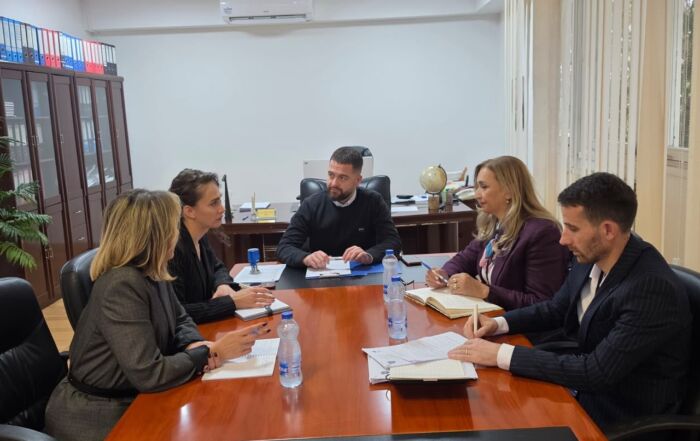
The Monitoring Division has commenced the monitoring process for the 2026/2027 academic year, within the scope of its mandate and responsibilities for overseeing the implementation of quality standards in higher education institutions. Today, monitoring activities [...]
4th KAA Annual Conference 2026 Successfully Concluded
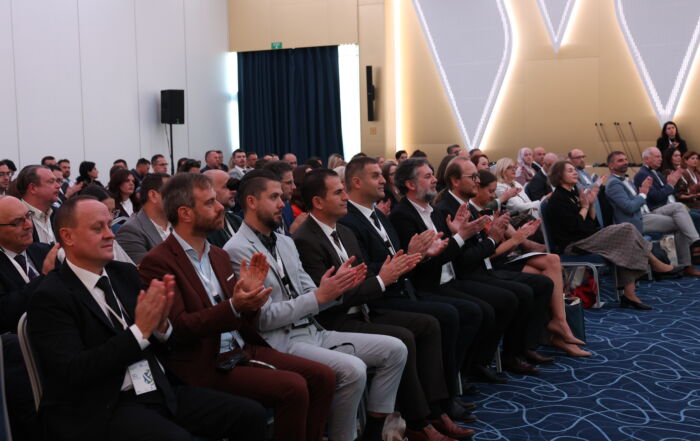
The Kosovo Accreditation Agency (KAA) successfully held its 4th Annual Conference on 29 September 2026 in Prishtina, under the theme “Internal Quality Assurance in Higher Education Institutions: From Evaluation to Quality Culture”. The conference brought [...]
SCQ Held Its Regular Meeting
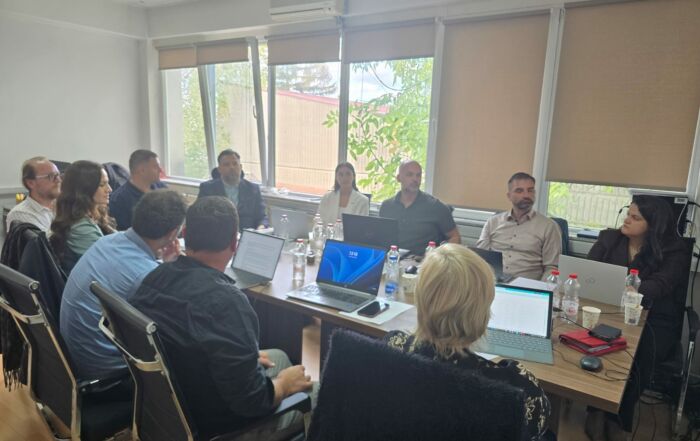
The State Council of Quality (SCQ) of the Kosovo Accreditation Agency (KAA) held its regular meeting on 28 September 2026, during which a number of important matters related to quality assurance in higher education in [...]
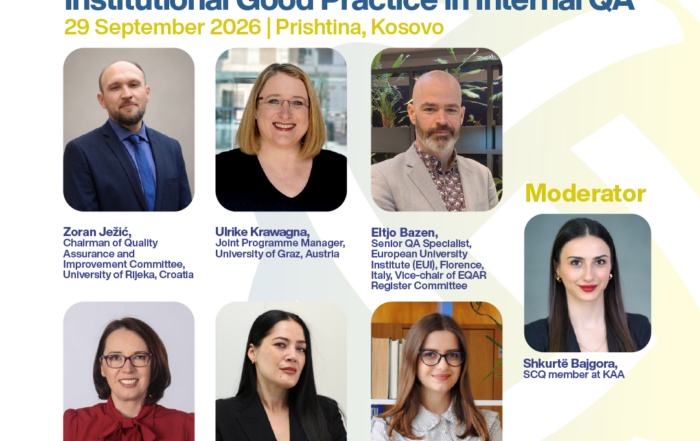
Panel 2: “Institutional Good Practice in Internal Quality Assurance”
Panel 2: “Institutional Good Practice in Internal Quality Assurance” will bring together Zoran Ježić, Ulrike Krawagna, Eltjo Bazen, Majlinda Gjelaj, Furtuna Mehmeti, and Fortina Kastrati, offering diverse perspectives and experiences from higher education institutions in [...]